
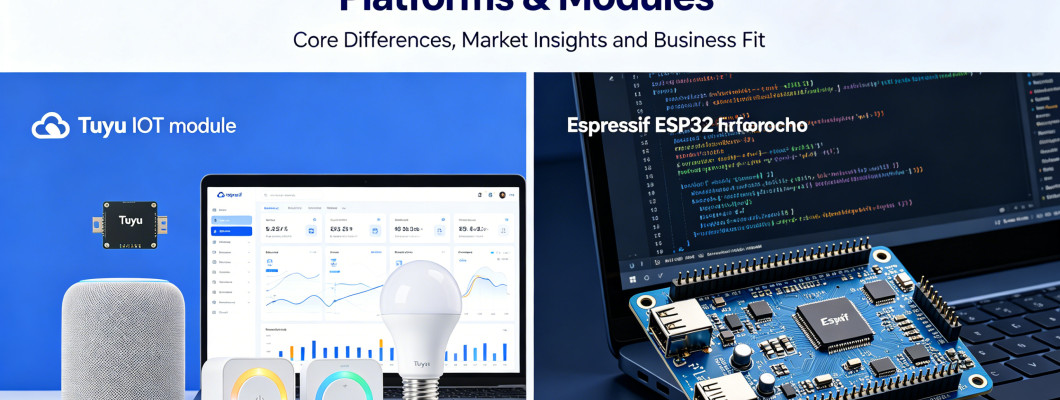
Introduction
In the global B2B smart home market, choosing the right IoT platform and hardware module is a make-or-break decision for importers, distributors, OEM/ODM manufacturers, and brand owners. Two dominant players have emerged to shape the industry: Tuya Smart Platform (with its turnkey modules) and Espressif ESP Platform (with its flexible DIY module ecosystem).
While both power millions of smart home devices worldwide, they cater to entirely different B2B needs, technical capabilities, and market segments. Confusing Tuya’s all-in-one solution with Espressif ESP’s DIY-focused approach can lead to costly mistakes—whether you’re launching a new product line, scaling production, or targeting specific global markets (EU, US, Southeast Asia, etc.).
This blog breaks down the core differences between Tuya Smart Platform, Tuya modules, Espressif ESP Platform, and ESP module DIY. We’ll also analyze their B2B market positioning, pros and cons, and which solution is best for your business goals—from fast time-to-market to custom functionality and cost optimization.
Core Definitions: Tuya vs Espressif ESP (Platforms & Modules)
Before diving into differences, it’s critical to clarify what each term means—especially for B2B buyers who may confuse “platform” with “module” or “DIY” capabilities.
1. Tuya Smart Platform & Tuya Modules
Tuya is a full-stack IoT platform that offers end-to-end solutions for smart home products—combining cloud services, device management, app development, and pre-certified hardware modules. Tuya modules are pre-integrated with the Tuya platform, meaning B2B brands can plug them into their products (switches, plugs, lighting, etc.) and launch quickly without extensive technical development.
Key Tuya modules include WiFi modules (e.g., TYWE3S, TYWE1S), Zigbee modules (e.g., TYZS3S), and Bluetooth modules—all pre-loaded with Tuya’s firmware, cloud connectivity, and compatibility with voice assistants like Amazon Alexa and Google Assistant.
2. Espressif ESP Platform & ESP Module DIY
Espressif Systems is a semiconductor company best known for its ESP series of microcontrollers (MCUs) and IoT development platforms. The Espressif ESP Platform refers to its software ecosystem (ESP-IDF, ESP Home) and hardware modules (e.g., ESP32, ESP8266), which are designed for custom DIY and development.
ESP module DIY involves taking Espressif’s bare modules (or development boards) and customizing the firmware, cloud integration, and functionality to meet specific product needs. Unlike Tuya, Espressif does not offer a turnkey IoT platform—instead, it provides the building blocks for B2B brands with in-house development teams to create fully custom solutions.
Key Differences: Tuya vs Espressif ESP (Platforms, Modules & DIY)
The biggest distinction between Tuya and Espressif ESP lies in their “turnkey vs. custom” approach. Below is a detailed comparison tailored to B2B smart home businesses, covering technical, operational, and market-related factors:
1. Technical Complexity & Development Requirements
- Tuya (Platform + Modules):Low technical barrier. Tuya modules come pre-programmed with firmware, cloud connectivity, and app support. B2B brands need minimal development resources—just integrate the module into their product hardware, customize the app (white-label option), and launch. No in-house IoT development team is required.
- Espressif ESP (Platform + DIY Modules):High technical barrier. ESP modules are “bare bones”—they require in-house developers to program firmware, integrate cloud services (e.g., AWS, Azure, or custom clouds), and build app support. ESP Home (an open-source framework) simplifies this, but it still requires coding expertise and IoT knowledge.
2. Time-to-Market & Scalability
- Tuya:Fast time-to-market (4-8 weeks). Pre-certified modules, ready-to-use cloud infrastructure, and white-label apps mean B2B brands can launch products quickly—critical for capitalizing on market trends (e.g., voice-controlled switches, smart plugs). Tuya’s platform also scales easily, supporting 100k+ devices without additional infrastructure.
- Espressif ESP DIY:Slow time-to-market (3-6 months). Custom development, firmware testing, cloud integration, and certification (CE, FCC, GDPR) add significant time. Scalability depends on the brand’s in-house capabilities—larger teams can scale, but small-to-medium B2B businesses may struggle with resource constraints.
3. Customization & Brand Control
- Tuya:Limited customization. While Tuya offers white-label apps and basic firmware tweaks, the core platform and module functionality are controlled by Tuya. Brands cannot fully customize the cloud backend or firmware—this can be a drawback for B2B brands looking to differentiate with unique features (e.g., custom data analytics, proprietary protocols).
- Espressif ESP DIY:Full customization. B2B brands have complete control over firmware, cloud integration, app design, and functionality. This is ideal for brands with unique product requirements (e.g., industrial smart devices, custom voice commands, or integration with niche IoT ecosystems).
4. Cost Structure
- Tuya:Low upfront cost, recurring platform fees. Tuya modules are affordable (typically $2-$5 per unit for bulk orders), and there’s no cost for basic cloud services. However, brands pay recurring fees for advanced features (e.g., custom analytics, high-volume device management) and white-label app upgrades.
- Espressif ESP DIY:High upfront cost, no recurring fees. ESP modules are slightly cheaper than Tuya modules ($1-$4 per unit), but the upfront cost of development (developers, testing, certification) is much higher. There are no recurring platform fees, as brands own the entire solution.
5. Certification & Compliance
- Tuya:Pre-certified modules. Tuya modules come with global certifications (CE, FCC, ROHS, GDPR, CCPA) pre-approved. This saves B2B brands time and money on certification—critical for entering regulated markets like the EU and US.
- Espressif ESP DIY:Self-certification required. Espressif modules are not pre-certified—brands must handle certification themselves, which is time-consuming and costly (typically $5k-$15k per certification). This is a major barrier for small B2B importers or distributors.
6. Voice Assistant & Ecosystem Integration
- Tuya:Out-of-the-box integration. Tuya modules are pre-integrated with Amazon Alexa, Google Assistant, and SmartThings. B2B brands don’t need to develop custom skills or actions—this simplifies product launch and increases market appeal.
- Espressif ESP DIY:Custom integration required. Brands must develop custom integrations for Alexa, Google Assistant, or other ecosystems. This adds development time but allows for more control over the voice experience (e.g., custom commands, branding).
B2B Market Analysis: Which Solution Fits Your Business?
Tuya and Espressif ESP DIY cater to distinct B2B market segments. Below is a breakdown of which solution is best for different types of smart home businesses:
1. Tuya (Platform + Modules): Ideal For
- B2B Importers & Distributors: Businesses without in-house development teams, looking to source ready-to-sell smart home products (switches, plugs, lighting) quickly. Tuya’s pre-certified modules and fast time-to-market reduce risk and simplify inventory management.
- OEM/ODM Manufacturers (Small-to-Medium): Brands looking to launch white-label smart home products with minimal investment. Tuya’s turnkey solution eliminates the need for expensive development and certification, allowing focus on production and sales.
- Brands Targeting Mass Markets: Businesses selling to mainstream consumers or small commercial clients (e.g., small hotels, offices) who prioritize affordability, compatibility, and quick availability over custom features.
- New Entrants to the Smart Home Industry: Brands new to IoT and smart home products, who need a low-risk, easy-to-implement solution to test market demand.
2. Espressif ESP DIY (Platform + Modules): Ideal For
- OEM/ODM Manufacturers (Large): Brands with in-house development teams, looking to create unique, differentiated smart home products (e.g., industrial sensors, custom commercial smart systems). Full customization allows for competitive differentiation.
- Specialized B2B Brands: Businesses targeting niche markets (e.g., medical smart devices, industrial IoT, high-end luxury smart homes) where custom functionality and brand control are critical.
- Brands with Long-Term Scalability Goals: Businesses that want to own their entire IoT ecosystem (no reliance on third-party platforms like Tuya) and avoid recurring platform fees. This is ideal for large-scale deployments (e.g., hotel chains, office campuses).
- Tech-Focused B2B Brands: Companies with expertise in IoT development, looking to leverage Espressif’s powerful MCUs (e.g., ESP32 for advanced connectivity, low power consumption) for high-performance products.
B2B Market Trends: Tuya vs Espressif ESP in 2026
The global smart home module market is projected to grow at a CAGR of 25% through 2030, with B2B sales accounting for 55% of total revenue. Here are the key trends shaping the competition between Tuya and Espressif ESP:
- Tuya’s Dominance in Mass B2B Markets: Tuya controls over 40% of the global smart home module market for B2B, thanks to its turnkey solution and pre-certification. It’s particularly strong in Southeast Asia, Europe, and North America for entry-level to mid-range smart home products.
- Espressif ESP’s Growth in Custom B2B Segments: Espressif is gaining traction in high-end and specialized B2B markets (industrial IoT, commercial smart spaces) due to its flexibility and powerful hardware. The ESP32 series, with its low power consumption and multi-protocol support (WiFi, Bluetooth, Zigbee), is becoming a top choice for custom solutions.
- Convergence of Turnkey & Custom Solutions: Tuya is adding more customization options (e.g., custom firmware, private cloud) to cater to mid-sized B2B brands, while Espressif is partnering with third-party cloud providers to simplify DIY integration—blurring the lines between the two platforms.
- Voice Integration as a Differentiator: Both Tuya and Espressif ESP are prioritizing Alexa and Google Assistant integration, but Tuya’s out-of-the-box support gives it an edge for B2B brands looking to launch voice-enabled products quickly.
How to Choose the Right Solution for Your B2B Business
To decide between Tuya and Espressif ESP DIY, ask yourself these 4 key questions:
- Do you have an in-house IoT development team? If no → Tuya. If yes → Espressif ESP DIY (or Tuya for quick launches).
- What’s your time-to-market goal? If you need to launch in 2-3 months → Tuya. If you can wait 3-6 months for custom features → Espressif ESP DIY.
- Do you need full brand control and custom functionality? If yes → Espressif ESP DIY. If you prioritize affordability and speed over customization → Tuya.
- Which markets are you targeting? If you’re targeting regulated markets (EU, US) and want to avoid certification costs → Tuya. If you’re targeting niche markets with custom requirements → Espressif ESP DIY.
Conclusion
Tuya Smart Platform and Espressif ESP Platform are not competitors—they are complementary solutions for different B2B smart home businesses. Tuya is the ideal choice for brands looking to launch quickly, minimize risk, and tap into mass markets with pre-certified, turnkey modules. Espressif ESP DIY is perfect for brands with development capabilities, seeking full customization, brand control, and differentiation in specialized markets.
For most B2B importers, distributors, and small-to-medium OEM/ODM brands, Tuya offers the best balance of speed, cost, and market appeal. For large OEM/ODM brands and specialized businesses, Espressif ESP DIY provides the flexibility to create unique, high-value products that stand out in a crowded market.
The key is to align your choice with your business goals, technical capabilities, and target market—whether that’s quick time-to-market with Tuya or custom innovation with Espressif ESP.
Need Help Choosing the Right Smart Home Module & Platform?
We provide B2B OEM/ODM smart home solutions tailored to your needs—whether you’re looking to leverage Tuya’s turnkey modules or customize Espressif ESP modules for your product line. Our team handles technical integration, certification, and customization, ensuring your products are compliant with global regulations (GDPR, CE, FCC) and optimized for your target markets.
Contact us today to discuss your project and find the perfect platform/module solution for your B2B smart home business.
Contact Us: marketing@towosmart.com|Whatsapp: 0086 18188647735| www.towosmart.com
Tags: #TuyaVsEspressifESP #TuyaSmartPlatform #EspressifESP #B2BSmartModules #ESP32DIY #TuyaModules #SmartHomeB2B #IoTPlatforms
Leave a Comment